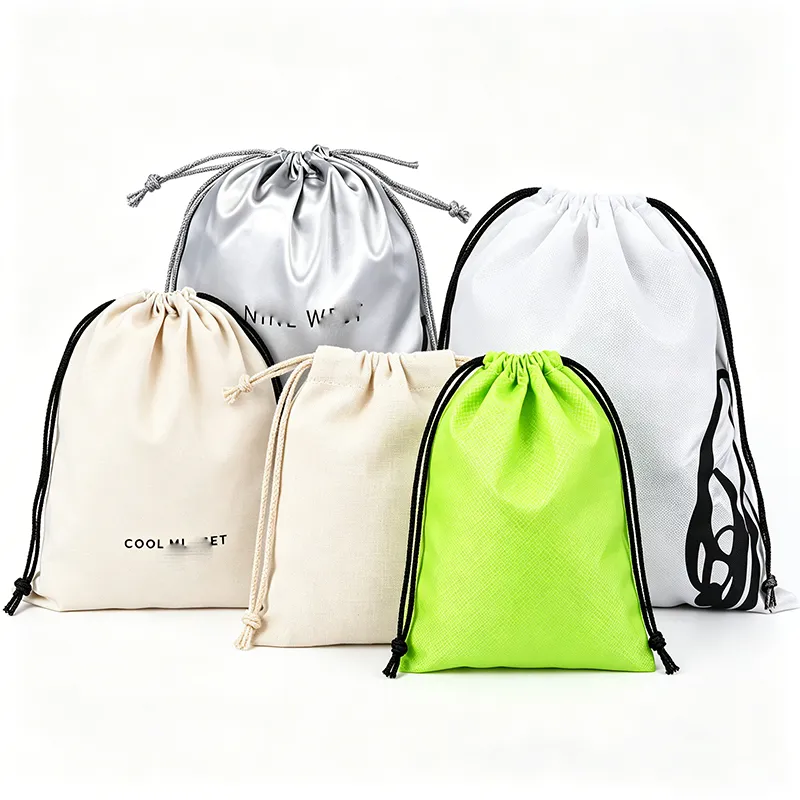
Whether for product packaging, promotional giveaways, or everyday storage, the material of a drawstring bag directly impacts cost, durability, and brand image. This drawstring bag material guide systematically compares five common fabrics: cotton, polyester, canvas, Oxford, and non-woven. It covers weight range, water resistance, abrasion resistance, printability, eco-certifications (e.g., GRS), unit cost, and typical applications, then provides a 5-step decision tree to help you quickly find the best solution.
After reading this guide, you will no longer struggle with “which fabric to choose” and will be able to ask more professional questions when sourcing from suppliers.
1. Cotton – Natural, Eco-Friendly, Soft but Wrinkle-Prone
Cotton drawstring bags are made from natural fibers. They are soft, breathable, and biodegradable. Disadvantages include easy wrinkling, high shrinkage, and poor water resistance. Ideal for gift packaging and eco-conscious brands.
Real case: An organic tea brand used undyed natural cotton drawstring bags as inner packaging with jute labels, successfully building a “zero plastic, all natural” brand image; customer repeat purchase rate increased by 25%.
Internal link: See our article “Why Are Cotton Drawstring Bags More Expensive?” for detailed cost analysis.
2. Polyester – Durable, Water-Resistant, Best Value
Polyester is a synthetic fiber – strong, wrinkle-resistant, quick-drying, and offers good water resistance. Low cost makes it ideal for large-volume orders. Disadvantages: slippery feel and non-biodegradable. Commonly used for sports equipment packaging, outdoor giveaways, and travel organizers.
Real case: An outdoor gear company ordered 10,000 polyester drawstring bags for a mountain climbing event with bold logo prints. The bags were distributed in the rain – contents stayed dry, and after repeated use, no wear was visible. The client called them “the toughest giveaway bags ever.”
Internal link: For more data, read “Most Wear-Resistant: Canvas, Oxford or Polyester?”
3. Canvas – Thick, Wear-Resistant, High Load Capacity
Canvas is usually made from cotton or linen but is denser and heavier than plain cotton. Excellent abrasion resistance and load-bearing capacity make it ideal for tool bags and shopping totes. Disadvantages: stiff feel, less foldable, higher cost.
Real case: A hardware tool brand customized canvas drawstring tool bags for repair technicians. The bags held several kilograms of screwdrivers and pliers, and after three months of heavy use on construction sites, no damage occurred – significantly enhancing brand professionalism.
4. Oxford Fabric – Lightweight, Tear-Resistant, Perfect for Electronics
Oxford fabric is woven from fine-denier fibers. It is lightweight, highly tear-resistant, and often coated for water resistance. Not bulky, making it especially suitable for electronics, eyewear, and precision instruments. Disadvantages: slightly plasticky feel and moderate eco-friendliness.
Real case: An earphone accessory brand chose 300D Oxford drawstring bags with anti-static lining for true wireless earbuds. The static discharge issue during shipping was solved, and the return rate dropped from 7% to 0.5%.
Real case: A skincare brand included a non-woven drawstring bag as a simple storage pouch with every order during a major annual promotion. Unit cost was only $0.03 per bag, effectively reducing packaging expenses while customers appreciated the extra utility (even if “better than nothing”).
5. Non-Woven – Lowest Cost, Disposable First Choice
Non-woven fabric is made by thermally bonding polypropylene (PP) fibers – not woven. Extremely low cost and can be made stiff like paper. Commonly used for event giveaways, promotional bags, or outer快递 packaging. Environmental controversy: partially degradable but production is not eco-friendly, and printing tends to be blurry.
Real case: A skincare brand included a non-woven drawstring bag as a simple storage pouch with every order during a major annual promotion. Unit cost was only $0.03 per bag, effectively reducing packaging expenses while customers appreciated the extra utility (even if “better than nothing”).
Comparison Table – Key Parameters (Parameters as Rows, Fabrics as Columns)
| Parameter | Cotton | Polyester | Canvas | Oxford | Non-Woven |
| Weight range (gsm) | 120–250 | 80–200 | 250–450 | 150–300 | 60–120 |
| Water resistance | Poor (absorbs water) | Good (excellent after coating) | Fair (can be coated) | Good (usually PU coated) | Fair (not waterproof) |
| Abrasion resistance | Medium | Good | Excellent | Excellent (tear-resistant) | Poor (easy to fuzz) |
| Print quality | Good (screen/heat transfer) | Good (vibrant heat transfer) | Fair (good for solid colors) | Good (fine details possible) | Fair (flexo printing blurry) |
| Eco-certification (e.g., GRS) | GOTS, Oeko-Tex | Recycled polyester (GRS optional) | Organic cotton certified | Few have GRS | None |
| Unit cost (bulk 10k) | Medium ($0.60–1.20) | Low ($0.30–0.70) | High ($0.90–1.80) | Medium ($0.50–1.00) | Very low ($0.10–0.30) |
| Typical applications | Gift packaging, eco-bags | Sports bags, promotional giveaways | Tool bags, shopping totes | Electronics accessories, eyewear pouches | Shipping outer bags, one-time promo bags |
5-Step Decision Tree: How to Choose the Best Fabric for Your Needs
You don’t need to memorize parameters. Answer the five questions below to find your ideal fabric according to this drawstring bag material guide.
- Product weight (load requirement)
- Less than 200g (e.g., cosmetics, small jewelry) → Non-woven or lightweight polyester
- 200g – 1000g (e.g., books, boxed gifts) → Oxford or Cotton
- Over 1000g (e.g., tools, sports equipment) → Canvas
- Need water resistance?
- Yes → Prioritize coated polyester or PU-coated Oxford; cotton and canvas need extra treatment (adds cost)
- No → Any material, consider other factors
- Environmental requirements
- Must be biodegradable → Choose natural cotton or hemp blends; avoid polyester and non-woven
- Recycled content acceptable → Choose GRS-certified recycled polyester
- No strict requirement → Focus on cost or functionality
- Print complexity (logo detail)
- Simple text / solid colors (≤2 colors) → All materials work, even non-woven
- High‑precision photo / gradients → Polyester heat transfer is best; cotton and Oxford are next; non-woven is worst
- Budget (unit cost)
- Very low (<$0.30) → Non-woven
- Low ($0.30–0.70) → Polyester
- Medium ($0.50–1.20) → Oxford or Cotton
- High (>$0.90) → Canvas or premium organic cotton
Summary recommendations:
- For durability and value → Polyester
- For natural eco‑friendly feel → Cotton
- For heavy loads or frequent use → Canvas
- For electronics or precision accessories → Oxford
- For one‑time events or lowest cost → Non-Woven
This drawstring bag material guide covers all key parameters and decision logic for the five mainstream fabrics. We hope it helps you make more accurate and professional choices in your next sourcing project.
Need Samples or Customization Advice? Contact Us
Material selection is only the first step – real quality must be verified through samples. Request a free sample pack containing swatches of cotton, polyester, canvas, Oxford, and non-woven (including small finished bags) to feel the texture, thickness, and print quality yourself.
→ Contact our team for free samples and one‑on‑one material advice
This guide is original. For more drawstring bag knowledge, visit our Resource Center.
Recommended Further Reading:
 We like to do design according to all the customers' requirements, or offer them our new designs. With strong OEM/ODM capabilities, we can fill your sourcing demands.