As a packaging material and finishing expert, I often see B2B buyers specify beautiful finishing effects (lamination, varnishing, foiling, embossing, spot UV) only to find that the chosen paper board cannot support them – resulting in foil peeling, lost embossing, or bubbling lamination.
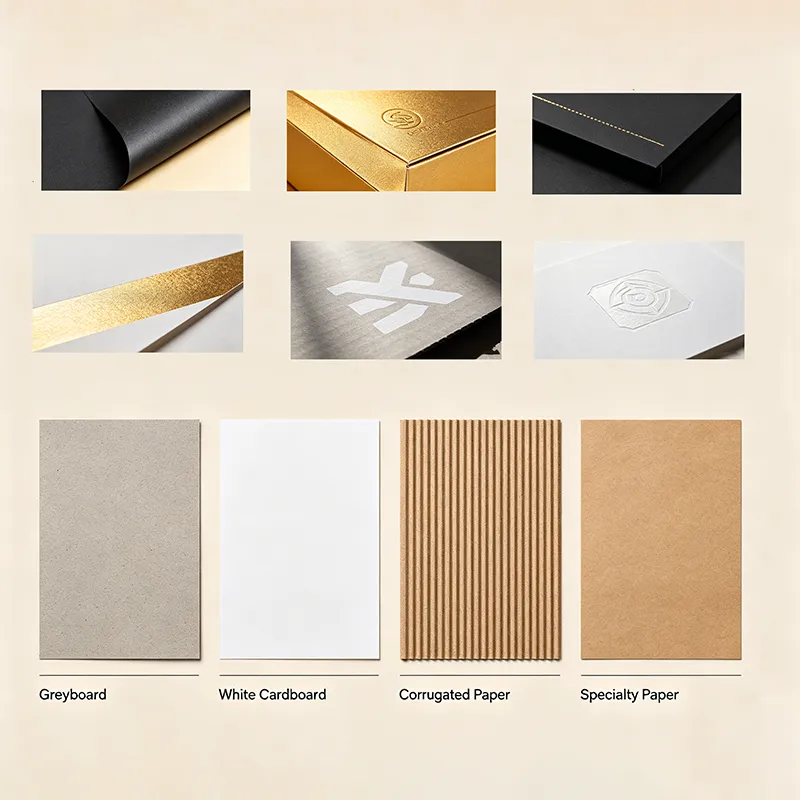
This guide focuses on paper box finishing techniques for four common paperboards: chipboard, ivory board, corrugated board, and specialty paper. You will learn which finishes work, which do not, and why. We also cover custom printed jewelry boxes and insights from a rigid boxes manufacturer.
1. Chipboard – The Rigid Box Core (Surface Paper Required)
Chipboard is made from recycled pulp – dense and rigid but highly absorbent. Never apply varnish or UV coating directly to chipboard. All surface finishes must be applied on the laminated surface paper.
✅ Suitable finishes (after laminating surface paper):
- Hot foil stamping – excellent results, ideal for luxury rigid boxes.
- Embossing – creates deep tactile patterns, great for logos.
- Lamination (gloss/matte) – protects the surface paper and adds premium feel.
❌ Unsuitable finishes (directly on chipboard):
- Varnish / UV coating – the board absorbs too much coating, leaving a dull, uneven finish.
- Spot UV – cannot form the required raised gloss layer.
Real case: A rigid boxes manufacturer received a request for a spot UV logo directly on chipboard. The UV oil fully soaked into the board – no visible effect. Solution: laminate a white card layer first, then apply spot UV on that layer. Perfect result.
Rigid Jewelry Boxes vs. Paper Jewelry Boxes: A Comparative Analysis for Brand Decision-Making
2. Ivory Board – Most Versatile, Works with Almost Every Finish
Ivory board is made from pure wood pulp. Its smooth, white surface accepts nearly all paper box finishing techniques. Ideal for cosmetic boxes, jewelry boxes, and electronics packaging.
✅ Strongly recommended finishes:
- Lamination (gloss/matte) – improves durability and feel.
- Aqueous / UV varnishing – fast drying, eco‑friendly, can be spot or full.
- Hot foil stamping – excellent adhesion, sharp lines for logos.
- Embossing – creates deep textures. Note: For embossing depth, use board thickness ≥350 gsm. Thinner boards may crack.
- Spot UV – bright and raised, ivory board is the best substrate for spot UV.
⚠️ Use with care:
Deep embossing on thin ivory board (<300 gsm) – risk of cracking. Always test a sample.
Real case: A brand ordered custom printed jewelry boxes with 350 gsm ivory board, combining matte lamination + foil stamping + spot UV. All three finishes worked without conflict and won a packaging award.
3. Corrugated Board – Structural Strength, Limited Fine Finishes
Corrugated board has a fluted inner layer and uneven surface. Best for shipping boxes and simple finishing.
✅ Suitable finishes:
- Flexo varnishing – water‑based, fast, cost‑effective for e‑commerce boxes.
- Simple foil stamping – requires special low‑temperature, high‑elongation foil. Best for large solid areas (avoid fine lines). Uneven surface may cause broken foil on fine details.
- Die‑cut windows – easy to add product display openings.
❌ Unsuitable finishes:
- Fine embossing – the fluted core collapses and springs back; details disappear.
- Spot UV – uneven surface leads to patchy, non‑level UV coating.
- Lamination – poor adhesion and high cost, bubbles often appear.
Real case: An electronics brand wanted spot UV on a corrugated shipping box. The UV layer was thick on flutes and thin in valleys – rejected. They switched to flexo varnish + simple foil logo, reducing cost by 40% while meeting shipping requirements.
4. Specialty Paper (Textured) – Preserve the Texture, Avoid Lamination
Specialty paper has natural grain, linen, leather, or stone texture. Never cover it with film lamination – that destroys the tactile appeal.
✅ Strongly recommended finishes:
- Hot foil stamping – creates high contrast between smooth foil and textured paper, very premium.
- Embossing – can enhance existing texture or add new patterns (use light pressure to avoid crushing the base texture).
❌ Not recommended:
- Lamination (any type) – completely hides the natural texture, wasting the high cost of specialty paper.
- Varnishing – also fills the texture and changes the feel.
- Spot UV – may be possible only if the texture height difference is <0.3 mm. Deeper textures cause uneven coating.
Real case: A luxury brand requested matte lamination on stone‑textured specialty paper. After lamination, the stone texture became flat and smooth – the premium paper lost its value. Correct solution: no lamination, only foil stamping on the logo, preserving the natural feel.
Crafting Elegance: The Art of Jewelry Packaging Design
Process‑Board Compatibility Matrix (Vertical Table)
| Finishing Process | Chipboard (with surface paper) | Ivory Board | Corrugated Board | Specialty Paper |
|---|
| Lamination | ✅ Strongly recommended | ✅ Recommended | ❌ Not recommended | ❌ Never use |
| Varnishing / UV | ❌ Not recommended directly | ✅ Recommended | ⚠️ Flexo varnish only | ❌ Not recommended |
| Hot Foil Stamping | ✅ Recommended | ✅ Strongly recommended | ⚠️ Simple shapes only | ✅ Strongly recommended |
| Embossing | ✅ Recommended | ✅ Recommended | ❌ Not recommended | ✅ Recommended |
| Spot UV | ✅ Possible (after surface paper) | ✅ Strongly recommended | ❌ Not recommended | ⚠️ Texture depth <0.3mm |
| Overall Rating | ⭐⭐⭐ | ⭐⭐⭐⭐⭐ | ⭐⭐ | ⭐⭐⭐⭐ |
3‑Step Decision Process for Paper Box Finishing
- Step 1 – Determine the paper board based on product weight, protection needs, and budget (chipboard, ivory, corrugated, or specialty).
- Step 2 – Define your product positioning
- Luxury → specialty paper + foil/embossing, avoid lamination.
- Eco‑friendly → ivory board + water‑based varnish (no lamination).
- Cost‑sensitive → corrugated + flexo varnish.
- Premium gift box → chipboard with surface paper + lamination + foil + embossing.
- Step 3 – Select the best finishing combination from the “allowed” list in the matrix. Always request physical samples before bulk production.
When sourcing custom printed jewelry boxes, always prioritize board‑finish compatibility. A professional rigid boxes manufacturer follows these paper box finishing techniques to avoid costly mistakes.
Foil Stamping, Embossing, and Spot UV on Jewelry Packaging: How to Increase Brand Premium?
Factory Sampling Tips for Finishing Validation
- Lamination adhesion: Test peel strength after 24 hours. No bubbles or delamination.
- Foil stamping: Rub test with tape – foil should not lift. Check fine lines for breaks.
- Embossing depth: Measure with a caliper; ensure no backside cracking.
- Spot UV: Check levelness and gloss under light.
Sample request script: “Please send 5 samples of each proposed board+finish combination. We will perform adhesion, rub, and drop tests.”
Need Samples or Custom Finishing Advice?
Choosing the right paper board and finishing process is critical for your packaging success. Request free sample boards (chipboard, ivory, corrugated, specialty) with different finishes to test feel and performance.
FAQ – Frequently Asked Questions
- Can chipboard take spot UV directly? No. The board absorbs UV oil, leaving no raised gloss. You must laminate a surface paper first.
- Why is corrugated board not good for fine foil stamping? The uneven surface causes inconsistent pressure – the foil breaks on valleys. Only large, simple shapes work with special foil.
- Does lamination ruin the feel of specialty paper? Yes. Lamination covers the natural texture. Use foil or embossing instead.
Recommended Further Reading:
 We like to do design according to all the customers' requirements, or offer them our new designs. With strong OEM/ODM capabilities, we can fill your sourcing demands.